
What Is a RESNET HERS Rater and Why Does It Matter?
A RESNET HERS rater is a certified professional trained to inspect and test homes, then assign them an energy efficiency score called a HERS Index rating. Here’s a quick overview:
| Term | What It Means |
|---|---|
| RESNET | Residential Energy Services Network — the national standards body for home energy ratings |
| HERS Rater | A certified professional who inspects, tests, and scores a home’s energy performance |
| HERS Index | A scoring scale where 100 = a standard reference home and 0 = net-zero energy |
| Lower score | Better energy efficiency — each point down = 1% less energy use |
| How to find one | Search the RESNET directory at hersindex.com |
More than 4.8 million homes across the U.S. have been HERS-rated to date. With nearly 6,600 active certified raters nationwide, this system has become the gold standard for measuring residential energy performance.
Whether you’re building a new home, applying for ENERGY STAR certification, or trying to meet a local energy code, a HERS rater is often the key professional who makes it happen.
I’m Edward Beauchemin, a residential designer and building performance specialist based in New England, and through my home performance company Energy Geeks I work directly with RESNET HERS raters on blower door testing, insulation, and energy modeling for custom homes and ADUs. That hands-on experience shapes everything in this guide.
Understanding the HERS Index and the Role of a RESNET HERS Rater
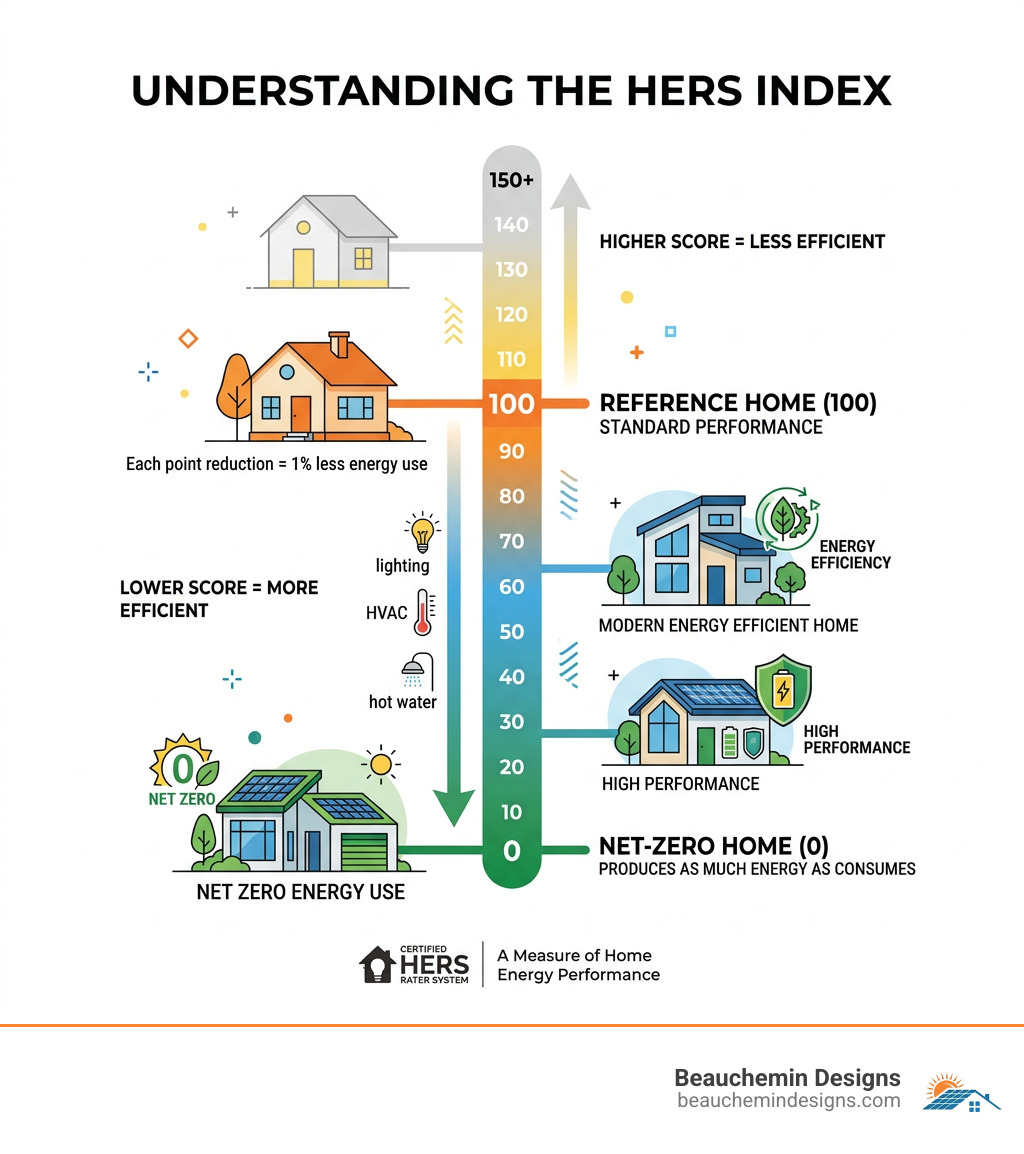
To understand the professional, we first have to understand the yardstick they use: the HERS Index. Think of it like a “miles per gallon” sticker for a house. Developed by RESNET, the HERS Index provides a standardized way to compare the energy efficiency of different homes.
The scale is based on a “Reference Home,” which is a model of a home built to the specifications of the 2006 International Energy Conservation Code (IECC). This reference home is assigned a score of 100. A home that scores a 0 is a net-zero energy home—meaning it produces as much energy as it consumes over a year.
With 4,894,002 homes HERS-rated to date, and over 43,000 already rated this year, the industry has a massive database of comparables. This allows for third-party verification that is statistically significant and highly reliable. For us at Beauchemin Designs, this data is invaluable when we design high-performance custom homes in places like Newton, MA, or Providence, RI, where the climate demands precision.
What is a HERS Index Score?
The HERS Index score is a numerical representation of a home’s energy consumption. The math is simple but powerful: for every one-point decrease in the HERS Index, the home is roughly 1% more efficient than the reference home. So, a home with a HERS Index of 70 is 30% more energy-efficient than the standard 2006 code-built home.
But it’s not just about electricity and gas anymore. Modern HERS Raters are now looking at the bigger picture. This includes the HERS Carbon Index, which measures the operational carbon footprint of a home, and HERSH2O, a specialized rating for water efficiency. As water prices rise faster than energy prices in many New England coastal towns like Hingham and Newport, water efficiency is becoming a major part of the conversation.
The Vital Role of the RESNET HERS Rater in Modern Construction
A RESNET HERS rater isn’t just a guy with a clipboard. They are highly trained diagnostic specialists. They perform a battery of tests—from checking insulation quality to measuring how much air leaks through the walls.
Their role is critical because they provide an unbiased, third-party evaluation. Builders use them to prove they met the code; homeowners use them to ensure they aren’t buying a “lemon” that will cost a fortune to heat in a Boston winter. If you are looking for a professional to guide your project, you can Find a certified RESNET HERS Rater through the official RESNET portal. They provide the energy-saving recommendations that turn a “good” house into a “great” one.
The Path to Certification: How to Become a RESNET HERS Rater
Becoming a rater isn’t something you do over a weekend. It’s a rigorous process overseen by RESNET to ensure quality assurance. The entire journey, from the first class to final certification, must be completed within a 15-month timeline.

The first step is finding an accredited Rating Provider. This provider acts as a mentor and is responsible for your ongoing quality assurance. You can’t just be a “lone wolf” in this industry; you must have a formal rater agreement with a provider who reviews your work.
Required Training and National Exams
Candidates typically start with about 20 hours of accredited coursework. This covers building science, heat transfer, and how to use complex energy modeling software. After the training, there are three major hurdles:
- National Rater Exam: A 55-question test covering the technical side of energy ratings. You need a 73% (40 correct questions) to pass.
- RESNET Combustion Appliance Simulation Test: Safety first! This simulation tests your ability to identify dangerous back-drafting or gas leaks. The passing score is a high 85%.
- RESNET Rater Simulation Practical Test: This is a virtual “walk-through” of a house where you must identify features and perform tests. You need a 73% to pass.
For those interested in the broader field, learning about energy conservation services is a great way to supplement this technical knowledge.
Completing Probationary Ratings and Field Requirements
Passing the tests makes you a “candidate,” but not a “Certified Rater.” To earn your stripes, you must complete a minimum of five probationary ratings under the supervision of a Certified Field Assessor.
During these ratings, you’ll practice data collection and onsite inspections. Your Rating Provider will review every file to ensure you aren’t missing a single detail. This structure is why the HERS brand is so trusted—there is layers-deep quality assurance. Before you hire someone, you should always Verify a rater’s credentials and standing on the RESNET registry.
The HERS Rating Process: From Plans to Performance
At Beauchemin Designs, we believe the rating process should start long before the first nail is driven. We use “early-stage HERS modeling” to test our designs.
The process follows a specific workflow:
- Plan Review: The rater takes our architectural plans and inputs them into accredited software. This generates a “Projected Index.”
- Mid-Construction Inspection: The rater checks the “Thermal Bypass Checklist,” looking at insulation and air sealing before the drywall goes up.
- Final Inspection: Once the house is finished, the rater performs diagnostic tests like Blower Door Testing and duct leakage testing.
Projected vs. Confirmed Ratings
| Phase | Goal | Key Output |
|---|---|---|
| Projected (Pre-Construction) | Design for efficiency | Estimated HERS Score |
| Confirmed (Post-Construction) | Verify real-world performance | Final Certified HERS Index |
Onsite Inspections and Diagnostic Testing
This is where the “magic” happens. Raters use specialized tools like infrared cameras to find missing insulation and blower door fans to measure airtightness. This is vital for Indoor Air Quality, as a house that is too tight without proper ventilation can become unhealthy, while a house that is too leaky is drafty and expensive.
The rater also performs HVAC commissioning, ensuring the furnace or heat pump is sized correctly. This scientific approach, codified in ANSI RESNET/ICC Standard 380, ensures that the data is consistent whether the house is in Concord, MA, or Westerly, RI.
Final Certification and Quality Assurance
Once the tests are done, the rater submits the data to their Rating Provider. The provider performs a 10% file review (checking the math) and a 1% field QA (where a supervisor actually goes to the house to re-test). If everything passes, the home is listed on the RESNET Registry and a certificate is issued. This certificate might even include information on Geothermal Heat Pumps or other advanced systems that helped achieve a low score.
Why Builders and Homeowners Need a Certified Rater
In New England, the “Stretch Code” and the latest IECC updates mean that meeting energy standards is no longer optional—it’s the law. A resnet hers rater is the builder’s best friend in this environment.
Benefits for Builders and Building Officials
Building officials in towns from Arlington to Worcester are often stretched thin. They rely on HERS Raters as third-party inspectors to verify code compliance. For builders, having a rater on the team reduces callbacks and ensures the home qualifies for lucrative rebates.
Under the Inflation Reduction Act, builders can access the 45L tax credit, which offers up to $5,000 for homes that meet high-efficiency standards like ENERGY STAR or Zero Energy Ready Home. To get that money, you must have a HERS Rater. Many raters also hold the ICC IECC/HERS Compliance Specialist designation, making them dual-certified experts in both the HERS Index and the building code.
Value for Homeowners and Appraisers
For homeowners, a low HERS score means lower utility bills and a more comfortable home. But it also means higher resale value. A Freddie Mac study found that HERS-rated homes sell for more than unrated comparable homes.
Appraisers can use the RESNET Appraisal Portal to find data on over 2 million rated homes, allowing them to give proper credit for “green” features that might otherwise be overlooked. This ensures your investment in a high-performance envelope actually shows up in your home’s valuation.
Professional Designations: Raters, RFIs, and Modelers
Not everyone in the HERS world is a “Rater.” There is a hierarchy of professionals who help get the job done.
The Rating Field Inspector (RFI)
An RFI is a technician who works under the direct supervision of a HERS Rater. They are trained to perform the field data collection—the “grunt work” of running the blower door and measuring windows. They are a great entry point into the industry, but they cannot sign off on a final HERS certificate; only a Rater can do that.
Standardizing Accuracy with the RESNET HERS Rater Modeler Designation
In 2020, RESNET introduced the HERS Modeler certification. This was done to ensure that the people sitting behind the computer inputting data are just as accurate as the people in the field. Certified HERS Raters are automatically granted this title, but others can earn it by completing HERS Modeler Certification requirements, which includes software-specific training. This ensures that a house modeled in Brookline will get the same score as the same house modeled in Warwick.
The HERS Associate and Affiliate Designations
Not everyone wants to crawl through attics. The HERS Associate and HERS Affiliate designations are for professionals like us—architects, designers, and code officials—who need to understand the system without necessarily performing the tests. The HERS Affiliate online training portal offers a quick, two-hour course that provides the foundational knowledge needed to collaborate effectively with raters.
Frequently Asked Questions about HERS Raters
How do I find and verify a certified HERS Rater?
The best way is to use the RESNET directory. You can search by zip code to find pros serving your specific area, whether that’s the North Shore or the Berkshires. You can also Find a HERS Rated Home if you are curious about the performance of a property you are looking to buy.
What is the difference between a HERS Rater and a Rating Field Inspector (RFI)?
Think of the Rater as the “Doctor” and the RFI as the “Nurse Practitioner.” The RFI gathers the vitals (duct leakage, blower door numbers), but the Rater makes the final diagnosis and issues the official certification. You can use the Rater/RFI verification tool to check anyone’s current standing.
How often must a HERS Rater recertify?
Raters must recertify every three years. To do so, they must complete 18 hours of approved professional development courses. This keeps them up to date on new technologies, software updates, and changes to the building code.
Conclusion
At Beauchemin Designs, we don’t treat energy performance as an “add-on.” Our envelope-first approach means we design for the New England climate from the very first sketch. By integrating everything you need to know about HERS Raters into our workflow, we ensure that our clients in Massachusetts and Rhode Island get homes that are as durable and efficient as they are beautiful.
Whether you are a builder looking to meet the Stretch Code or a homeowner dreaming of a net-zero sanctuary, a resnet hers rater is your most valuable ally in the quest for a high-performance home. Together, we can build a future that is comfortable, sustainable, and measurably better.