
Why EV Smart Home Integration Is the Future of Home Energy
EV smart home integration connects your electric vehicle’s charging system to your home’s energy ecosystem — letting you automate when, how, and how much your car charges based on solar production, utility rates, or battery state.
Here’s what that can look like in practice:
| Goal | How Smart Integration Helps |
|---|---|
| Cut charging costs | Schedule charging during off-peak utility hours |
| Use free solar energy | Auto-charge when solar panels produce excess power |
| Backup power during outages | Use your EV battery to power your home (V2H) |
| Monitor energy use | Track kWh per session from a single app |
| Manage multiple EVs | AI scheduling balances shared circuits automatically |
Most homeowners don’t realize their EV charger can do far more than just charge a car. With the right hardware and software, it becomes an active part of your home’s energy strategy — one that can lower bills, reduce grid dependence, and even keep your lights on during a blackout.
But getting there requires understanding which chargers, ecosystems, and installation approaches actually work together — especially in New England, where energy costs and climate demands make smart planning even more critical.
I’m Edward Beauchemin, a residential designer and building performance specialist with decades of experience designing high-performance homes across New England, including systems-level planning for EV smart home integration, solar readiness, and whole-home electrification. Let’s walk through exactly what you need to know to do this right.
Understanding EV Smart Home Integration and Charging Technology
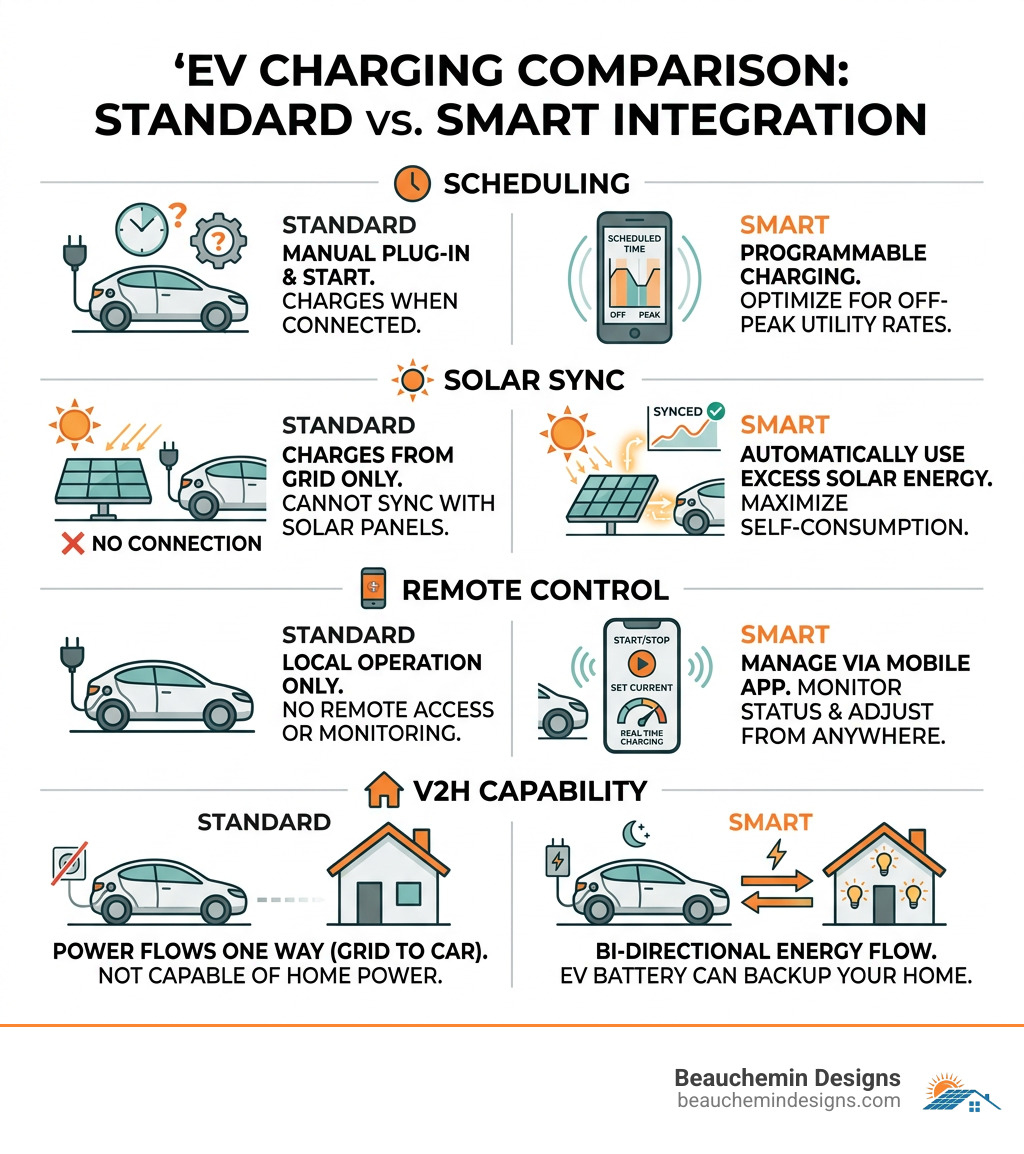
When we talk about EV smart home integration, we are moving far beyond the “dumb” Level 1 charger that came with your car. A standard charger is essentially a glorified extension cord; it provides power whenever it’s plugged in, regardless of what the rest of your house is doing.
A smart Level 2 charger, however, is a networked device. It uses Wi-Fi or Bluetooth to communicate with your smartphone, your solar inverter, or even a home automation hub like Home Assistant. This connectivity allows for remote monitoring and intelligent control. For homeowners in Massachusetts or Rhode Island, where electricity rates can be among the highest in the country, this control is the difference between a $30 monthly charging bill and a $100 one.

| Feature | Level 1 (Standard) | Level 2 (Smart) |
|---|---|---|
| Voltage | 120V (Standard Outlet) | 240V (Dedicated Circuit) |
| Charging Speed | 3–5 miles per hour | 25–50+ miles per hour |
| Connectivity | None | Wi-Fi / Bluetooth / Ethernet |
| Scheduling | Manual (Plug/Unplug) | App-based / Automated |
| Energy Tracking | None | Real-time kWh monitoring |
| V2H Capability | No | Yes (with compatible hardware) |
The Benefits of ENERGY STAR and Safety Ratings
We always advise our clients to look for the ENERGY STAR® certification. These chargers are roughly 40% more efficient than non-certified models during “standby” mode—the time the charger is just sitting on your wall waiting for the car to come home. In a region like New England, where we focus heavily on Energy Conservation Renewable Energy, those small phantom loads add up.
Safety is equally paramount. Ensure your charger is UL Listed. EV charging pulls a massive amount of current for 4 to 6 hours straight. A standard dryer outlet might handle a 50-minute cycle, but it isn’t always built for the sustained thermal stress of an EV. Smart chargers also benefit from over-the-air (OTA) firmware updates, ensuring your hardware stays compatible with new vehicle software and evolving safety standards.
Choosing the Right Smart EV Charger for Your Ecosystem
The “best” charger isn’t just about the hardware; it’s about how well it talks to the rest of your house. If you use the My Leviton app for your lights, or an Enphase system for your solar, you’ll want a charger that slides into that existing unified interface.
Best Chargers for EV Smart Home Integration with Home Assistant
For the “prosumer” or the DIY automation enthusiast, Home Assistant is the gold standard. It allows you to create complex automations, like turning on your mudroom lights when the car starts charging after sunset.
- OpenEVSE: This is the favorite for those who want total control. It uses the MQTT protocol and is hardware-agnostic, making it the easiest to integrate deeply with Home Assistant.
- Wallbox Pulsar Plus: A very popular choice in New England because of its compact size and local control capabilities via the OCPP (Open Charge Point Protocol). This means you don’t have to rely on the “cloud” to talk to your charger.
- Emporia: Known for its affordability and excellent energy monitoring. It integrates well via HACS (Home Assistant Community Store).
- ChargePoint & Grizzl-e: Reliable workhorses. While ChargePoint often requires a cloud connection for its residential units, Grizzl-e offers rugged, “dumb” versions and smart versions that support OCPP for local integration.
Leviton and Enphase: Whole-Home Energy Management
If you prefer a “set it and forget it” ecosystem, established brands like Leviton and Enphase offer incredible depth. Over 75% of homes in the US already have at least one Leviton device, and their smart load centers (electrical panels) allow you to track the exact kWh usage of your EV through smart breakers.
Enphase has taken this a step further with their bidirectional chargers. By integrating with their microinverters and the Enphase App, you can manage power flow between your car, your home, and the grid. Their systems often come with a 10-year warranty, providing the long-term durability we prioritize in our architectural designs.
Optimizing Energy: Solar Excess and Off-Peak Scheduling
One of the most powerful aspects of EV smart home integration is “solar tracking.” If you have solar panels on your roof in Providence or Worcester, you often produce more power than your house needs during the day. Normally, that excess goes back to the grid for a small credit.
With smart integration, you can use “CT clamps” (sensors that wrap around your main power lines) to detect when you are exporting power. Your smart charger can then automatically ramp up its speed to “catch” that solar energy, effectively filling your car with free, 100% renewable fuel. This is a core pillar of our Energy Conservation Renewable Energy strategy.
Automating Your Charge with Home Assistant
By using Home Assistant, you can move beyond simple schedules. You can create scripts for:
- Peak Shaving: Automatically pausing the charger if the house’s total energy draw exceeds a certain limit (to avoid tripping a main breaker or hitting high utility demand charges).
- SOC Limits: If you live in a hilly area, you might want to stop charging at 80% so your car has “room” in the battery to store energy from regenerative braking as you drive downhill.
- Dynamic Scheduling: Syncing with your utility’s Time-of-Use (TOU) rates to ensure you only charge when the grid is least stressed and prices are lowest.
Vehicle-to-Home (V2H): Using Your EV as a Backup Power Source
This is the “holy grail” of EV smart home integration. Your EV is essentially a giant battery on wheels. A fully-charged Kia EV9 can power a standard suburban home for about three days when paired with a bidirectional charger like the Wallbox Quasar 2.
plus installation costs for these systems are higher than standard chargers, but the resilience they provide is unmatched. according to GM Energy website, a 2024 Silverado EV First Edition RST can provide home backup for up to 21 days if you manage your loads carefully.
To enable this, you typically need:
- A V2H-compatible vehicle (like the Ford F-150 Lightning or Silverado EV).
- A bidirectional charger (like the GM PowerShift or Enphase IQ).
- A V2H Enablement Kit (which includes a transfer switch to safely disconnect your home from the grid during an outage).
Multi-EV Households and AI Management
If your family has two or more EVs, you might run into “panel capacity” issues. Solutions like CleverCharge use AI to manage shared circuits. Instead of upgrading your entire electrical service (which can cost thousands), the AI balances the load between the cars, ensuring both are ready by morning without overloading your home’s system. This eliminates range anxiety while protecting the long-term health of your vehicle batteries.
Planning Your Installation: Costs, Safety, and Load Management
In our work as HERS Raters, we often see homeowners underestimate the infrastructure needed for high-speed charging.
- Load Management: If you have an older 100-amp or 150-amp service in a historic New England home, adding a 50-amp EV charger can be tricky. Smart electrical panels or load-shedding devices can “pause” the charger when the electric oven or dryer is running, preventing the need for a costly utility service upgrade.
- Heavy-Duty Receptacles: If you aren’t hardwiring the charger, use a high-quality NEMA 14-50 outlet. Cheap, builder-grade outlets are not designed for the heat generated by hours of EV charging.
- Incentives: Many utilities in Massachusetts and Rhode Island offer significant rebates for ENERGY STAR chargers. Combined with federal tax credits, the net cost of a smart charger can often be lower than a “dumb” one.
Future-Proofing with EV Smart Home Integration APIs
The technology is moving fast. Platforms like the Smartcar API are allowing software developers to integrate with over 30 different EV brands without needing extra hardware in the car. This hardware-free approach means that even if you switch from a Tesla to a Rivian, your smart home energy management system can likely still talk to your car to set charge limits or check battery status.
Frequently Asked Questions about EV Smart Home Integration
Can any EV power my home during a blackout?
No. Your vehicle must have bidirectional charging hardware and software (V2H). Currently, this is limited to specific models like the Ford F-150 Lightning, the Nissan LEAF, and newer GM and Kia models. You also need a compatible bidirectional charger and a home transfer switch.
What is the best EV charger for Home Assistant users?
For total flexibility and local control, OpenEVSE or a charger that supports the OCPP protocol (like Wallbox) is best. These allow Home Assistant to talk directly to the charger without needing to go through an external company’s server.
Are there financial incentives for installing smart chargers?
Yes! In addition to federal tax credits, many local New England utilities provide rebates specifically for smart chargers because they help the utility manage grid demand. Always check your local utility’s website before purchasing.
Conclusion
At Beauchemin Designs, we believe a home should be more than just a shelter; it should be a high-performance system that works for you. EV smart home integration is a vital part of that vision. By syncing your car with your home, you aren’t just adopting new tech—you’re building a more resilient, cost-effective, and sustainable lifestyle.
Whether you are building a new custom home in Concord, adding an ADU in Providence, or retrofitting an existing property for climate resilience, planning for Energy Conservation Renewable Energy and EV readiness today will save you thousands tomorrow. Let’s design a home that’s ready for the future.