An Honor—and a Reflection of How We Think About Homes
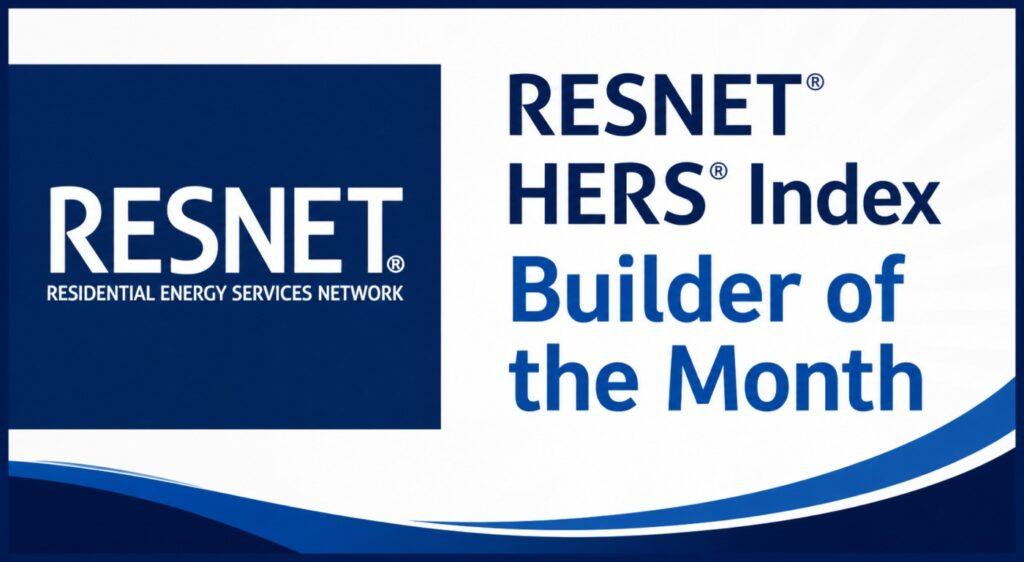
We’re honored to be named the May 2026 RESNET® HERS® Index Builder of the Month.
Recognition like this matters to us, not just because of the award itself, but because of what it represents. It reflects a way of thinking about homes that we’ve believed in for a long time—one that prioritizes performance, not just appearance.
“A HERS-rated home takes the guesswork out of performance. It’s not just labeled efficient—it’s measured and verified.”
From the outside, many homes look the same. What’s harder to see is how they actually live day to day. That’s where performance comes in.
Designing for Performance, Not Assumptions
Most buyers focus on what they can see: finishes, layout, curb appeal. Those things matter—but they don’t tell you how the home is going to feel in January, or in the middle of a humid August stretch.
“Most buyers focus on what they can see. The HERS score tells you how the home is actually going to live.”
For us, the HERS score isn’t a marketing feature. It’s a design tool.
We use energy modeling early in the process to understand how decisions around insulation, air sealing, windows, and mechanical systems will perform long before construction begins. The final score simply confirms whether the home is doing what it was designed to do.
That approach is grounded in a broader philosophy: homes should be designed as systems, not as a collection of parts—a theme we explore throughout our New England high-performance home guide .
Why This Matters More in New England
New England puts pressure on a home in ways that many other parts of the country don’t.
Temperature swings of over 100 degrees across the seasons, long heating periods, and high humidity levels create constant stress on materials and systems. A home that isn’t well thought out will show it—through drafts, uneven temperatures, moisture issues, and higher operating costs.
That’s why we take an envelope-first approach. Before thinking about finishes or even mechanical systems, we focus on how the home will manage heat, air, and moisture. Get that right, and everything else becomes more predictable. Get it wrong, and you spend the life of the home compensating for it.
Energy Efficiency Should Be the Baseline
One of the things we’ve said—and continue to believe—is that energy efficiency shouldn’t be the selling point anymore.
“At this point, energy efficiency should be the baseline—especially in New England.”
The conversation should be moving beyond “Is this home efficient?” to “How well does this home actually perform?” That includes comfort, indoor air quality, durability, and long-term cost of ownership. When a home is designed properly, efficiency is built in. It’s not something that needs to be added later—or marketed separately.
The Role of HERS—Clarity, Not Complexity
Most homeowners aren’t looking for a number when they start a project. They’re looking for a home that feels right. The HERS Index provides clarity around that experience. It creates a way to compare homes that might otherwise look identical on the surface, but perform very differently behind the walls.
It also introduces accountability. A home either performs the way it was modeled—or it doesn’t. That level of transparency is becoming more important as codes continue to evolve across Massachusetts, Rhode Island, and Connecticut.
A Process That Starts Early
One of the biggest differences in how we approach projects is when performance gets considered.
For us, it starts at the very beginning. We integrate energy modeling and building science into the design phase, working closely with partners like Energy Geeks to evaluate decisions before they become expensive to change.
“The earlier you think about performance, the fewer compromises you have to make later.”
It’s fundamentally different from trying to “value engineer” performance back into a project once construction is underway.
Looking Ahead
We’re grateful to RESNET® for the recognition. More importantly, we see it as validation of where the industry is heading. Homes are being asked to do more than ever—to be efficient, resilient, healthy, and adaptable to changing energy standards.
“We’re not designing homes to meet minimum standards—we’re designing them to perform.”
For us, that shift has already happened.
Thinking About Building?
Whether you’re a homeowner planning a new build, ADU, or aging-in-place design—or a builder focused on delivering higher-performing homes—we are happy to talk through how performance fits into your project from day one. Contact us today to start that conversation.