Solar Panels for Your Home: What Every Homeowner Should Know First
A guide to solar panels for home is exactly what most New England homeowners need right now — because energy costs keep climbing, and solar is one of the most practical ways to take back control.
Here’s a quick snapshot of what going solar involves:
- How it works – Solar panels convert sunlight into electricity for your home
- What it costs – A typical system requires a meaningful upfront investment, offset by tax credits and incentives
- What you save – Most homeowners see significant annual savings on electricity, which adds up to a substantial amount over 25 years
- Is your home ready? – South-facing roofs with minimal shading get the best results, but many homes qualify
- How long it takes to pay off – Most systems pay for themselves within 5 to 10 years
- What happens next – After installation, panels require very little maintenance and are warrantied for 25 years
The U.S. surpassed five million home solar installations in 2024 — and that number is expected to double by 2030. Electricity rates have risen 32% over the past decade alone. That trend isn’t slowing down.
For homeowners who care about long-term performance and energy efficiency, solar isn’t just an environmental choice. It’s a smart financial one.
I’m Edward Beauchemin, a residential designer and building performance specialist based in New England, and through both Beauchemin Designs and Energy Geeks I’ve spent years helping homeowners build and retrofit high-performance homes — including integrating solar-ready design into the work we do every day. This guide to solar panels for home is built on that real-world experience, so you get practical answers, not just theory.
Let’s start with the fundamentals.
Simple guide to guide to solar panels for home:
Understanding the Basics: How Residential Solar Works
To truly master a guide to solar panels for home, we have to look under the hood. Solar energy isn’t magic; it’s physics. Most residential solar panels are made of silicon, a semiconductor material that is the workhorse of the industry.
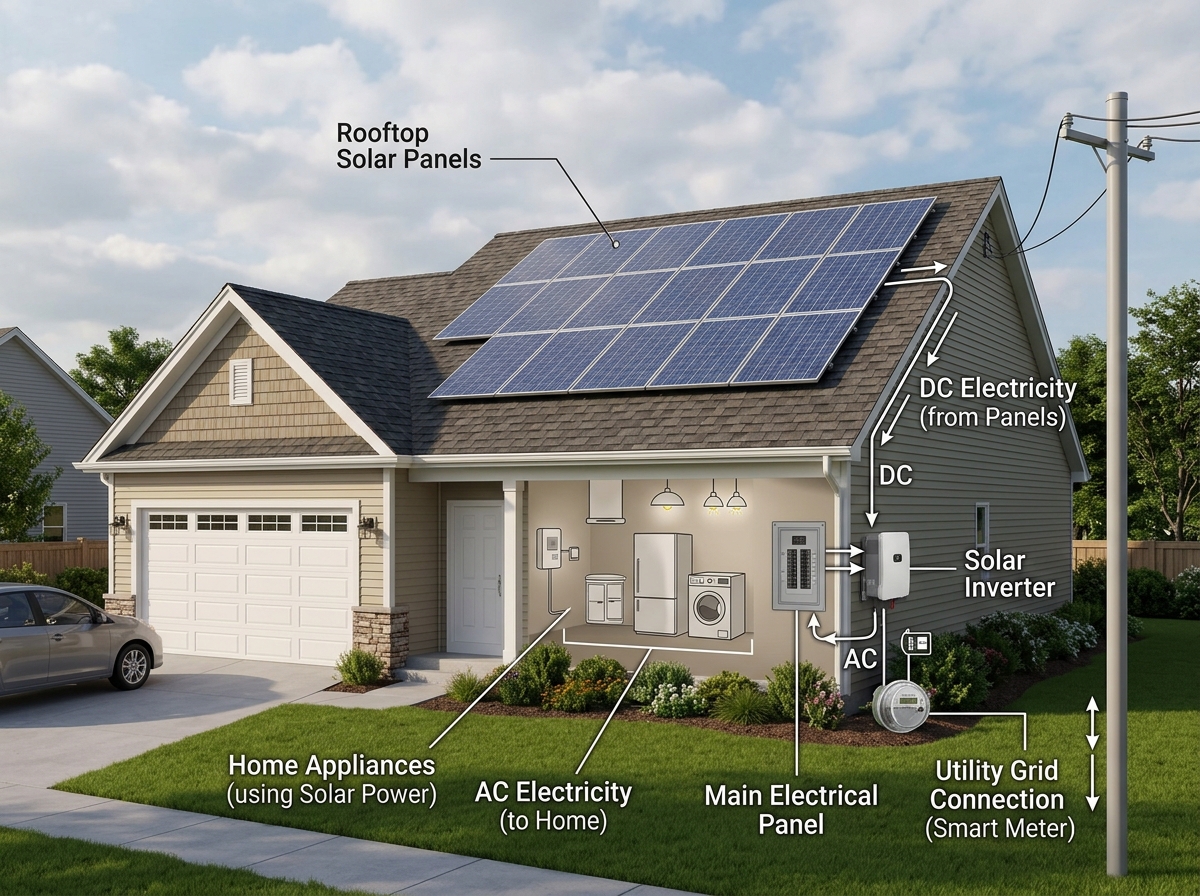
When sunlight hits these silicon cells, it triggers the photovoltaic effect. Essentially, the energy from the sun knocks electrons loose from their atoms, creating a flow of electricity. This flow is Direct Current (DC) electricity. However, your refrigerator, TV, and laptop all run on Alternating Current (AC).
That’s where the solar inverter comes in. It acts as the “brain” of the system, converting that DC power into usable AC power for your home. Any energy you don’t use immediately can either be sent back to the local grid (in a grid-tied system) or stored for later if you have a battery.
Supporting all of this is the racking system. In New England, where we deal with heavy snow loads and high winds, the racking must be robust. These systems securely anchor your panels to your roof or a ground mount, ensuring they stay put through every Nor’easter.
Key Components in a Guide to Solar Panels for Home
When you start reviewing quotes, you’ll see a lot of technical jargon. Here is the breakdown of what actually matters for your system:
- Monocrystalline Panels: These are the sleek, black panels you often see on modern homes. They are made from a single crystal of silicon, making them highly efficient and great for smaller roofs where space is at a premium.
- Polycrystalline Panels: These have a blue, marbled look. They are made from multiple silicon crystals melted together. While they are often more budget-friendly, they are generally less efficient than monocrystalline options.
- String Inverters: A single box that handles the conversion for the entire array. They are cost-effective but can be a drawback if one panel is shaded, as it can “drag down” the performance of the whole string.
- Microinverters: These are small inverters installed under every single panel. This means each panel operates independently. If a stray branch shades one panel, the rest of your system keeps humming along at full capacity.
- Power Optimizers: A hybrid approach where optimizers are placed on each panel to “condition” the DC power before sending it to a central string inverter.
At Beauchemin Designs, we believe solar works best when it is part of a larger strategy. We focus on Energy Conservation & Renewable Energy by ensuring your home’s “envelope”—the walls, windows, and roof—is airtight first. There is no point in putting a massive solar array on a home that leaks energy like a sieve!
Grid-Tied vs. Off-Grid Systems in a Guide to Solar Panels for Home
Most homeowners in Massachusetts and Rhode Island choose a grid-tied system. This means your home is still connected to the local utility company. When the sun is shining, you use your own power; when it’s dark, you pull from the grid. This setup allows for net metering, where the utility company gives you credit for the excess energy you send back to them.
Off-grid systems are entirely independent. These require massive battery banks to ensure you have power through the night and during cloudy stretches. While they offer ultimate independence, they are significantly more complex and expensive.
Hybrid systems are the rising star in New England. They are grid-tied but include a battery backup. This gives you the financial benefits of net metering with the peace of mind that your lights will stay on during a grid outage.
Assessing Your Property for a Guide to Solar Panels for Home
Before you fall in love with a specific panel brand, we need to see if your property is a good candidate. Not every roof is solar-ready, but with the right design, many can be.
- Roof Orientation: In the Northern Hemisphere, south-facing roofs are the gold standard. They receive the most direct sunlight throughout the day. However, east and west-facing roofs can still be very productive, often reaching eighty to ninety percent of the output of a south-facing roof.
- Tilt and Angle: A roof pitch between thirty and forty-five degrees is usually ideal for catching those rays.
- Shading Analysis: This is crucial. Even a small amount of shade from a chimney, a neighbor’s tree, or a dormer can significantly impact production. Professional installers use tools to map out the “solar window” of your roof across all four seasons.
- Structural Integrity: Solar panels and racking add weight. We always recommend having a structural check, especially on older New England homes. If your roof needs to be replaced in the next three to five years, it is almost always better to do the roof and the solar at the same time.
For a quick DIY estimate, you can use the PVWatts calculator provided by the National Renewable Energy Laboratory. It’s a great way to see the potential of your specific address.
Determining the Right System Size for Your Energy Needs
How many panels do you actually need? To find out, we look at your annual kWh (kilowatt-hour) consumption. You can find this on your past twelve months of utility bills.
We don’t just look at what you used last year; we look at what you’ll use tomorrow. Are you planning to add an electric vehicle? Are you switching from a gas furnace to high-performance heat pumps? We help our clients design for “electrification-ready” homes, ensuring the solar array can handle the future load of an all-electric lifestyle.
You can also use a System Estimator to get a ballpark figure on panel count based on your current usage and roof size.
The Financial Side: Costs, Incentives, and ROI
Let’s talk about the “return on investment” (ROI). While we don’t focus on specific price tags, it’s important to understand the mechanisms that make solar pay off. According to Solar Energy Industries Association (SEIA) data, the cost of solar has fallen significantly over the last decade, while utility rates continue to climb.
The biggest financial “win” is the Federal Investment Tax Credit (ITC). This allows you to deduct thirty percent of the cost of your solar system from your federal taxes. If you don’t owe enough in taxes in year one, you can often roll the credit over.
In our region, local New England rebates and state-specific programs (like the SMART program in Massachusetts) add even more value. Furthermore, studies show that solar panels can increase home value by nearly seven percent on average. When you combine bill savings, tax credits, and home value increases, most systems pay for themselves in under a decade.
If you’re looking at other ways to boost your home’s efficiency, we often suggest pairing solar with Geothermal Heat Pumps for a truly high-performance HVAC solution.
Financing Options in Your Guide to Solar Panels for Home
There are several ways to get solar on your roof, and the “best” one depends on your financial goals:
- Cash Purchase: This offers the highest long-term ROI. You own the equipment, you get the tax credits, and you get the full benefit of the energy savings.
- Solar Loans: Many New England banks offer specialized “green loans” with favorable rates. This allows you to own the system with little to no money down, and the monthly loan payment is often lower than your old electric bill.
- Solar Leases & PPAs (Power Purchase Agreements): In these scenarios, a third party owns the panels on your roof. You pay a fixed monthly fee (lease) or a set rate for the power produced (PPA). While this is a low-barrier way to go solar, you do not get the tax credits or the home value increase, and it can sometimes complicate a future home sale.
Installation and Long-Term Performance
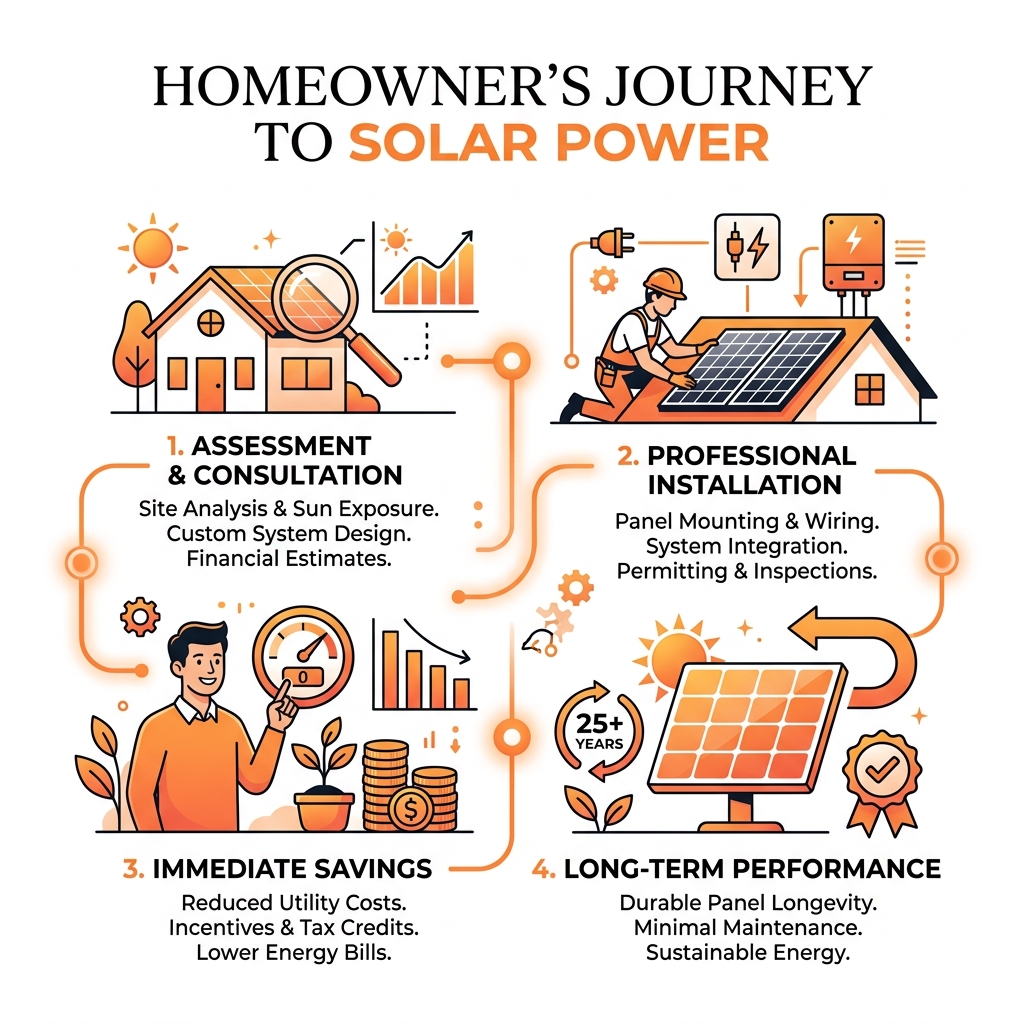
Once you’ve signed a contract, the real work begins. A professional installation isn’t just about bolting panels to shingles; it’s a multi-step process that involves engineering, permitting, and coordination with your utility company.
We always recommend looking for NABCEP certification when choosing an installer. This is the gold standard for solar professionals and ensures they have the training to handle complex electrical and structural requirements.
The process typically looks like this:
- Site Evaluation: An engineer confirms your roof’s condition and takes final measurements.
- Design & Permitting: The installer creates a technical plan and submits it to your local building department in towns like Concord, MA or East Providence, RI.
- Installation: The actual physical work usually takes only one to three days.
- Inspection: A local building inspector and the utility company must approve the work.
- Permission to Operate (PTO): The utility gives the green light to flip the switch!
Maintenance, Lifespan, and Battery Storage
One of the best parts of solar is that it has no moving parts. This means there is very little that can go wrong. Most panels are warrantied to produce at least eighty percent of their original power after twenty-five years.
Maintenance is minimal. In New England, rain usually does a fine job of keeping the panels clean. While you might see a dip in production if they are covered in heavy snow, the dark surface of the panels usually helps melt the snow quickly once the sun comes out.
We are seeing a massive shift toward lithium-ion battery storage. As net metering policies evolve, being able to store your own “sunshine” for use at night or during an outage is becoming a top priority for our clients. For more on the official government stance on these systems, check out the Homeowner’s Guide to Solar | Department of Energy.
Frequently Asked Questions about Home Solar
We hear a lot of “solar myths” while designing homes in places like Newton and Providence. Let’s clear a few up.
Do solar panels work in New England winters?
Absolutely! In fact, solar panels are actually more efficient in cold weather. While the days are shorter and snow happens, the cold temperatures help the electrical components perform better. Think of it like a computer—it runs better when it isn’t overheating.
Will solar panels damage my roof?
Not if they are installed correctly. In many ways, they actually protect the portion of the roof they cover from UV degradation and weather. A professional installer uses flashing and high-quality sealants to ensure every roof penetration is water-tight.
What happens to solar power during a grid outage?
If you have a standard grid-tied system without a battery, your solar will shut off automatically during an outage. This is a safety feature called “anti-islanding” that protects utility workers who might be fixing the lines. If you want power during an outage, you must have a battery backup or a specialized inverter with “daylight backup” capabilities.
Conclusion
At Beauchemin Designs, we don’t just see solar as an “add-on.” We see it as a fundamental component of modern, high-performance living. Whether we are designing a custom home in the Berkshires or an ADU in Cambridge, we prioritize an envelope-first design that makes solar more effective.
By integrating solar-ready infrastructure from the very beginning, we ensure your home is resilient, cost-effective, and ready for whatever the future of energy holds. If you are ready to stop being left in the dark and want to build a home that works for you, focusing on Energy Conservation & Renewable Energy is the best place to start.
Embrace the power of the sun and take a step towards a sustainable, energy-independent future. Your roof has been sitting there for years—isn’t it time it started working for you?