
What is a HERS Index Score? A Quick Guide for Homeowners
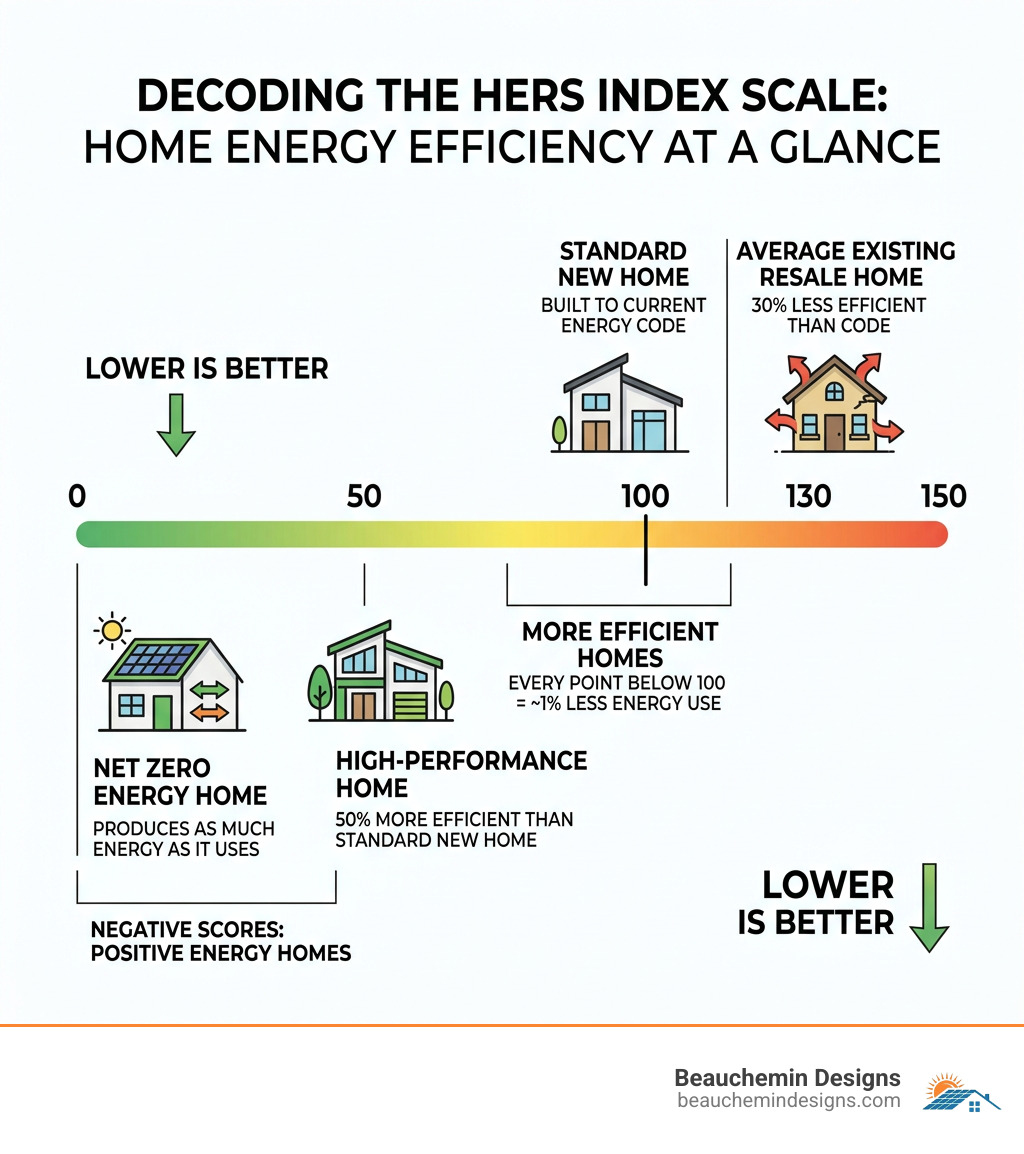
The HERS index score is the nationally recognized standard for measuring how energy-efficient a home is. Think of it like the MPG sticker on a car — one number that tells you how much energy a home uses compared to a baseline.
Here’s what the key scores mean at a glance:
| HERS Score | What It Means |
|---|---|
| 130 | Average existing resale home (30% less efficient than code) |
| 100 | Standard new home built to current energy code |
| 50 | 50% more efficient than a standard new home |
| 0 | Net Zero Energy home (produces as much energy as it uses) |
| Negative | “Positive Energy” home (produces more energy than it uses) |
Lower is better. Every point below 100 means roughly 1% less energy use than a code-built home.
The HERS scale runs from 0 to 150+. Most older homes score 130 or above. New homes built to code land around 100. High-performance homes — the kind designed with energy modeling from day one — often score 50 or below.
Over 4.7 million homes in the U.S. have been HERS rated, and the number grows every year as builders, buyers, and energy codes increasingly rely on it.
I’m Edward Beauchemin, a residential designer and building performance specialist with decades of experience designing high-performance homes across New England — including hands-on work with blower door testing, insulation, and energy modeling through my home performance company, Energy Geeks, where the HERS index score is a central tool in every project. In the sections below, I’ll walk you through exactly how the score is calculated, what different numbers mean in practice, and how to use it to make smarter decisions when building or buying a home.
What is the HERS Index and How is it Calculated?
The Home Energy Rating System (HERS) Index was developed by the Residential Energy Services Network (RESNET) in 2006. It is an ANSI-accredited standard that provides a linear scale for home energy performance. Unlike a simple energy audit, which might just suggest upgrades, a HERS rating provides a definitive numerical value that allows for an apples-to-apples comparison between different houses, regardless of their size or shape.
To calculate the score, a professional rater compares the home in question to a “Reference Home.” This reference is a computer-modeled version of the exact same house—same size, shape, and climate zone—but built to the minimum specifications of the 2006 International Energy Conservation Code (IECC). By comparing the actual home’s performance against this baseline, we can determine exactly how much more (or less) efficient it is.
This process is deeply rooted in building science. We look at how the building envelope, mechanical systems, and indoor air quality systems interact. At Beauchemin Designs, we believe that a home is a system, and the HERS Index is the best way to measure how well that system is functioning.
Calculating the HERS Index Score for New Construction
For a new home, the path to a low hers index score begins on the drawing board. We use simulation software to model the building plans before a single nail is driven. During construction and upon completion, several critical diagnostic tests are performed:
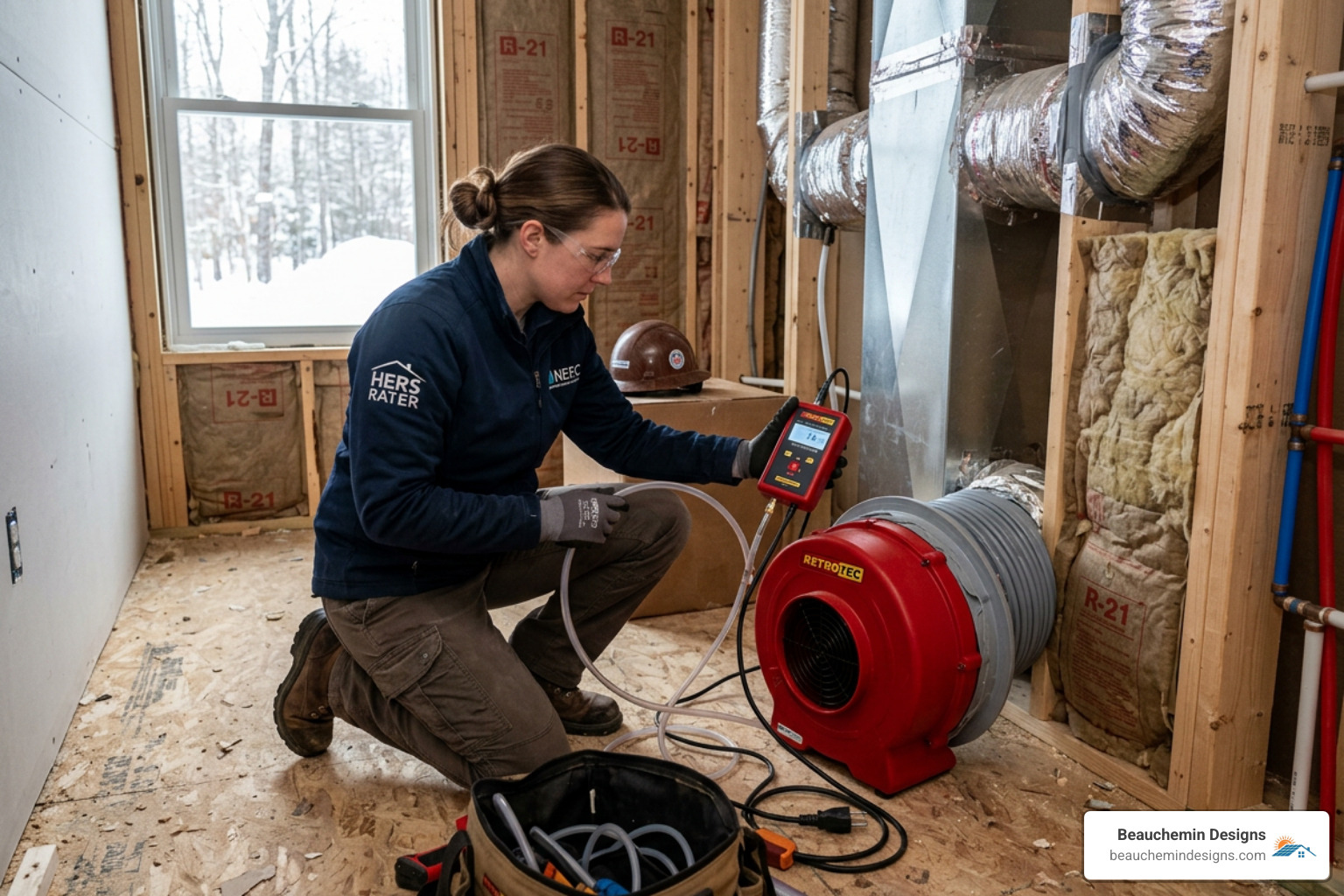
- Blower Door Testing: This measures the airtightness of the building envelope. A large fan is mounted in an exterior door frame to pressurize or depressurize the house, revealing exactly how much air is leaking through cracks and gaps. You can learn more about this in our guide to Blower Door Testing.
- Duct Leakage Testing: Even the best HVAC system will fail if the “veins” of the house—the ducts—are leaking conditioned air into unconditioned attics or crawlspaces.
- HVAC Sizing and Standard 310 Testing: Proper Standard 310 testing ensures that the HVAC contractor has installed the system correctly, verifying refrigerant charge, fan airflow, and watt draw.
- Thermal Bypass Inspection: We check for gaps in the insulation and “thermal bridges” where heat can easily escape through the structure.
- Orientation and Windows: The way a home sits on a lot in Massachusetts or Rhode Island significantly impacts its heating and cooling loads.
The Role of the Certified HERS Rater
A HERS rating is not a “DIY” project. It requires a certified professional who has undergone rigorous training and quality assurance oversight by RESNET. These HERS Raters act as independent third-party verifiers.
They don’t just take the builder’s word for it; they use specialized tools like thermal imaging cameras and manometers to prove the home’s performance. For homeowners in the New England region, having a certified rater involved ensures that the high-performance features you paid for are actually working. This third-party verification is what gives the hers index score its credibility in the mortgage and real estate industries.
Understanding Your HERS Index Score: From 130 to Net Zero
The beauty of the HERS scale is its simplicity. Because it is a linear scale, a home with a score of 70 is exactly 30% more efficient than the 100-point baseline. A home with a score of 50 is 50% more efficient.
| Home Type | Typical HERS Score | Efficiency vs. 2006 Code |
|---|---|---|
| Older Resale Home | 130+ | 30% Less Efficient |
| Standard New Home | 100 | Baseline |
| ENERGY STAR Certified | 60 – 70 | 30-40% More Efficient |
| High-Performance Custom | 40 – 50 | 50-60% More Efficient |
| Net Zero Energy Home | 0 | 100% More Efficient |
To see how these numbers translate into real-world savings, you can explore RESNET’s Interactive HERS Index tool.
What Different HERS Index Score Benchmarks Mean
- Score 130: This is the average for a typical resale home in the U.S. These homes often have leaky envelopes, outdated HVAC systems, and minimal insulation. They are “financial drains” that cost significantly more to operate.
- Score 100: This represents a home built to the 2006 energy code. While it’s better than an old house, it’s still just the “minimum passing grade.”
- Score 50: This is a fantastic target for a high-performance home. It means the house uses half the energy of a standard new home.
- Score 0: This is a “Net Zero Energy” home. Through a combination of an ultra-efficient envelope and renewable energy like solar panels, the home produces as much energy as it consumes over the course of a year.
- Negative Scores: Some homes go even further, becoming “Positive Energy” homes. These houses generate a surplus of energy that can be sold back to the grid or used to power electric vehicles.
You can verify the score of a specific property by searching the RESNET National Rating Registry.
How a HERS Index Score Impacts Resale Value
A low hers index score is a powerful marketing tool. Just as you wouldn’t buy a car without looking at the MPG, savvy homebuyers are now looking for the HERS sticker. Studies have shown that energy-efficient homes sell for an appraisal premium and have a 32% lower mortgage default rate.
When we designed this Two-Family Historic Home in Blackstone MA, the focus on energy performance ensured that the property would remain valuable and affordable for the long term. Lower utility bills mean more money in the homeowner’s pocket every month, which directly translates to higher purchasing power and better resale value.
Why a Low HERS Score Matters for New England Homeowners
In New England, our homes have to work harder. We deal with bitter winters, humid summers, and high precipitation. A low hers index score isn’t just about saving money; it’s about climate resilience.
Across Massachusetts and Rhode Island, energy codes are becoming increasingly strict. Many jurisdictions have adopted the “Stretch Code,” which requires a specific HERS target for all new construction. By aiming for a low score now, you are future-proofing your home against rising energy costs and evolving regulations. At Beauchemin Designs, we integrate Energy Conservation and Renewable Energy strategies from day one to ensure compliance and comfort.
Financial Incentives and Tax Credits
Building a high-performance home can be more affordable than you think, thanks to various incentives:
- Federal 45L Tax Credit: Builders can receive up to $2,500 for ENERGY STAR certified homes and $5,000 for Zero Energy Ready Homes that meet specific HERS targets.
- Energy Improvement Mortgages (EIMs): These allow borrowers to include the cost of energy-efficiency improvements in their mortgage.
- Utility Rebates: Many New England utility providers offer significant rebates for homes that achieve low HERS scores.
- Solar Incentives: Combining a tight envelope with Geothermal Heat Pumps and solar can lead to massive annual savings—sometimes close to $2,000 or more compared to a standard home.
Comfort and Health Benefits
A low HERS score is often a proxy for a healthier home. When a house is airtight and well-insulated, you eliminate the drafts that make New England winters feel colder. You also gain better control over humidity, which prevents mold growth and improves indoor air quality.
In projects like our Historic Duplex in Mansfield MA, we use high-performance design to ensure that every room stays at a consistent temperature, regardless of the weather outside. Balanced ventilation systems ensure a constant supply of fresh, filtered air, reducing allergens and pollutants.
The Path to a Certified Rating: Process and Costs
Getting a HERS rating involves a two-stage process.
- Provisional Rating: This is done during the design phase. We look at the architectural plans and model the expected performance. This allows us to run “what-if” scenarios. What if we add more attic insulation? What if we switch to triple-pane windows? This early modeling prevents costly changes later.
- Confirmed Rating: This is the final score. It is based on the actual “as-built” home, verified by on-site inspections and diagnostic testing (blower door, duct blaster, etc.) after construction is complete.
Steps to Get Your Home Rated
The process typically follows these steps:
- Plan Review: The rater analyzes the blueprints and specifications.
- Pre-Drywall Inspection: The rater visits the site to inspect the insulation installation and air sealing before the walls are closed up.
- Final Testing: Once the home is finished, the rater performs the final blower door and duct leakage tests.
- Certification: The data is entered into accredited software, and a final HERS Index certificate is issued, which is often required for a Certificate of Occupancy in many Massachusetts towns.
The cost for a full HERS rating typically ranges from $1,500 to $3,000, depending on the complexity of the home and the number of inspections required.
Improving an Existing Home’s Score
While the HERS Index is most common in new construction, it can also be used for major renovations. If you own an older home in New England, you can hire a rater to perform a “base” rating. From there, you can implement a series of retrofits:
- Envelope Sealing: Using spray foam or caulk to stop air leaks.
- Insulation Upgrades: Adding cellulose to the attic or dense-pack insulation to the walls.
- HVAC Upgrades: Switching to high-efficiency heat pumps.
- Solar Integration: Adding renewables to bring the score closer to zero.
Frequently Asked Questions about the HERS Index
What is the difference between HERS and ENERGY STAR?
The HERS Index is a scoring system (the ruler), while ENERGY STAR is a certification program (the gold star). To earn an ENERGY STAR label, a home must achieve a specific hers index score (usually in the 60s or 70s) AND meet a strict set of additional requirements from the EPA regarding water management and HVAC commissioning.
How much does a HERS rating typically cost?
As mentioned, expect to pay between $1,500 and $3,000. While this may seem like an extra expense, the energy savings and tax credits (like the $2,500 – $5,000 45L credit) usually pay for the rating many times over.
Can an older home achieve a HERS score of 0?
It is possible, but difficult. It requires a “deep energy retrofit,” which involves stripping the house down to the studs to maximize insulation and airtightness, followed by a significant solar array. Most older homes aim for a score of 50-70, which still represents a massive improvement over the typical 130+ score.
Conclusion
At Beauchemin Designs, we don’t treat energy efficiency as an afterthought. We use an envelope-first design philosophy, meaning we prioritize insulation and airtightness from the very first sketch. By incorporating early-stage HERS modeling into our architectural process, we ensure that every custom home, ADU, or renovation we design for our New England clients is measurably superior.
Whether you are building a new home in Newton, renovating a historic duplex in Providence, or planning an ADU in Worcester, understanding the hers index score is your first step toward a more comfortable, durable, and cost-effective future.
Ready to start your high-performance journey? Contact us for more info about HERS rating services and how we can integrate these standards into your next project.